Joseph and Pharaoh’s Dreams
Genesis 41 · Bible story for toddlers and preschoolers
Two strange dreams trouble the king of Egypt, and no one can explain them — until God helps Joseph, who has waited so long in prison.
The little story (ages 3–6, 7 min)
Joseph was still in prison in Egypt. Two whole years went by. Joseph waited and waited. But God had not forgotten Joseph.
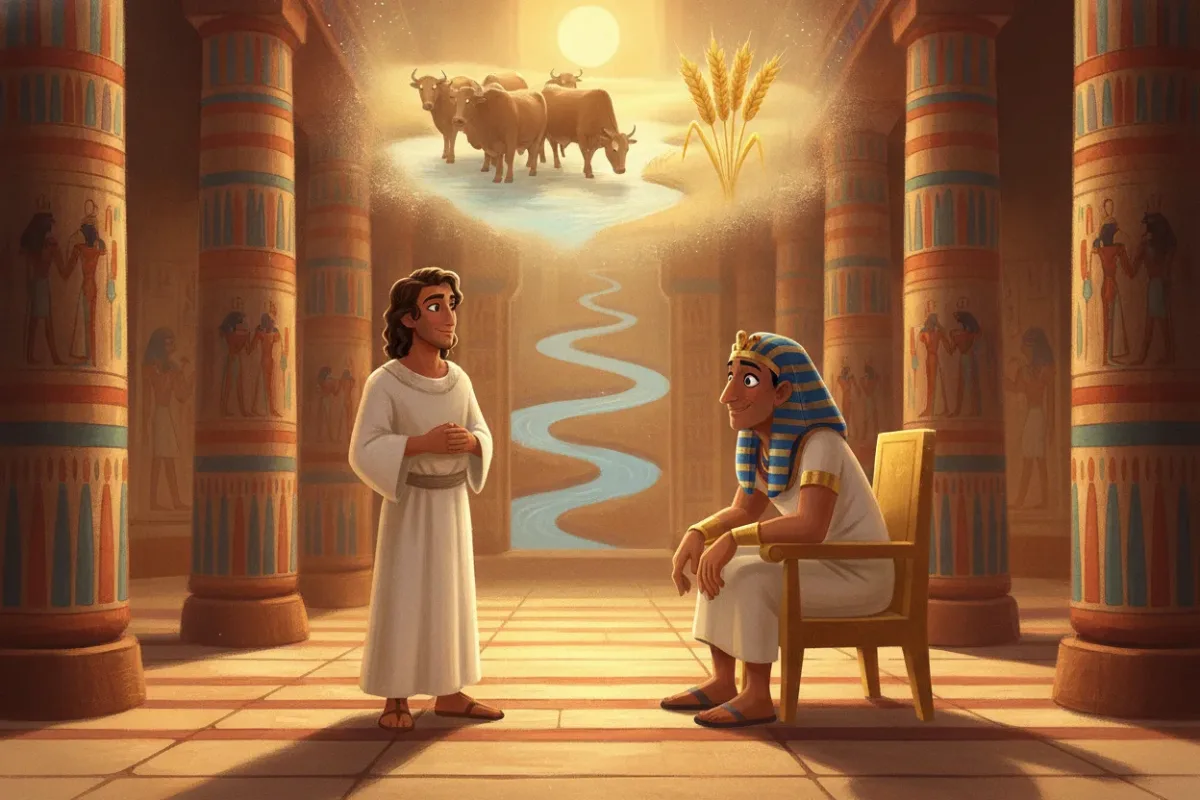
Then one night, the king of Egypt had a dream. The king is called Pharaoh. In his dream, he stood by a river.
Seven fat cows came up out of the river. They ate the grass. Let’s count them: one, two, three, four, five, six, seven! Moo!
Then seven more cows came up. These cows were very thin. The thin cows ate up the fat cows! Then Pharaoh woke up.
Pharaoh fell asleep again. He had a second dream. Seven good heads of grain grew on one stalk. Grain is what bread is made from. A stalk is the long stem of a plant.
Then seven thin heads of grain grew up. The east wind had dried them up. The thin heads swallowed up the good ones! Pharaoh woke up again.
In the morning, Pharaoh was worried. He called all the wise men of Egypt. He told them his dreams. But no one could say what they meant.
Then the king’s cupbearer spoke up. A cupbearer is a helper who brings the king his drinks. He had been in prison with Joseph. Now he remembered Joseph! God had not forgotten Joseph.
The cupbearer told Pharaoh about a young man in the prison. That young man had told what the dreams meant. And everything had come true! Pharaoh sent for Joseph right away. Joseph was brought quickly out of the prison. He cleaned up and put on fresh clothes. Then he went in to see the king.
Pharaoh said he had dreamed a dream. No one could tell him what it meant. He had heard that Joseph could. What do you think Joseph said?
Joseph said, “I can’t do it myself. God will give Pharaoh an answer of peace.” An answer of peace is a good answer. God had not forgotten Joseph.
Then Pharaoh told Joseph both dreams. Joseph said, “God has told Pharaoh what he is about to do.” The two dreams meant the same thing.
The seven fat cows were seven good years. The seven good heads of grain were seven good years too. There would be plenty of food! Can you rub your tummy? Yum, yum!
But the seven thin cows were seven hard years. So were the seven thin heads of grain. Then there would be a famine. A famine is a time when there is very little food.
Joseph had a wise plan. In the seven good years, the people should gather food. They should store the grain in the cities. Then there would still be food in the hard years.
Pharaoh liked the plan. He said that God had shown Joseph all this. No one was as wise as Joseph. So Pharaoh put Joseph in charge of all Egypt! God had not forgotten Joseph.
Pharaoh gave Joseph his own ring, a gold chain, and fine clothes. Joseph rode in a chariot. A chariot is a cart with big wheels. Joseph went out over all the land.
For seven years, the land gave plenty of food. Joseph stored the grain in the cities. He stored so much grain! It was like the sand by the sea. He stopped counting. Can you count sand? Too many!
Then the hard years began, just as Joseph had said. But in Egypt there was bread! The hungry people cried to Pharaoh. He said, “Go to Joseph. Do what he says to you.”
Joseph opened the storehouses. A storehouse is a big building for keeping food. People came to Joseph from many lands. God was with Joseph in the prison, and God was with him now. God had not forgotten Joseph.
Talk together
- How do you think Joseph felt when the king sent for him?
- What would you like to save for a hard day?
Memory verse for little ones
“God will give Pharaoh an answer of peace.” — Genesis 41:16
Pray together
Dear God, thank you that you never forget me. Help me trust you while I wait. Amen.
The whole story (ages 6+)
Joseph was still in prison in Egypt. Two whole years went by, but God had not forgotten Joseph. Then one night, Pharaoh, the king of Egypt, had a strange dream. He stood by the river, and seven fat cows came up out of the water. After them came seven thin cows, and the thin cows ate up the fat cows. Pharaoh woke up.
Pharaoh fell asleep again and had a second dream. This time, seven good heads of grain grew on one stalk, and then seven thin heads of grain grew after them. The thin ones swallowed up the good ones! In the morning, Pharaoh felt troubled. He told his dreams to all the wise men of Egypt, but no one could say what they meant.
Then the cupbearer spoke up. At last he remembered Joseph! He told Pharaoh about a young man in the prison who had explained his dream, and everything had happened just as that young man had said. Pharaoh sent for Joseph right away. Joseph cleaned up, put on fresh clothes, and went in to see the king.
Pharaoh told Joseph that he had dreamed a dream, and that no one could explain it. He had heard that Joseph could. Joseph answered Pharaoh, "I can't do this myself. God will give Pharaoh an answer of peace." Joseph gave the honor to God, just as he had in the prison. Then Pharaoh told him both dreams.
Joseph said, "God has told Pharaoh what he is about to do." The two dreams were really one dream with one meaning. The seven fat cows and the seven good heads of grain were seven good years, with plenty of food for everyone. But the seven thin cows and the seven thin heads of grain were seven hard years, with a famine — a time when there would be very little food.
Then Joseph gave Pharaoh some wise advice. In the seven good years, the people should gather food and store grain in the cities. Then, when the hard years came, there would still be food to eat. Pharaoh said that God had shown Joseph all of this, and that no one was as wise as Joseph. So Pharaoh put Joseph in charge of all Egypt.
Pharaoh gave Joseph his own ring, a gold chain, and robes of fine linen. Then Joseph went all over Egypt. For seven years, the land gave plenty of food, and Joseph stored up so much grain that it was like the sand of the sea. He even stopped counting, because there was too much to count!
Then the hard years began, just as Joseph had said. There was no food in many lands, but in Egypt there was bread. When the hungry people cried to Pharaoh, he told them, "Go to Joseph. Do what he says to you." Joseph opened the storehouses, and people from many countries came to buy grain. God was with Joseph in the prison, and God was with him now.
Tricky words
- Pharaoh — The name for the great king who ruled over Egypt.
- cupbearer — The king's helper who brought him his drinks in a cup.
- grain — The seeds of plants like wheat, used to make bread.
- famine — A time when there is very little food and people go hungry.
- chariot — A light cart with two wheels, used by important people.
- an answer of peace — A good answer that helps and brings calm.
Where is Jesus in this story?
Joseph was lifted out of the prison, and he used his place to feed hungry people who came to him from many lands. Many years later, Jesus fed hungry crowds too, and he gave his own life so that everyone could be rescued and belong to God. Joseph was a helper for many people in need, but Jesus is the greatest helper of all, and everyone is invited to come to him.
God does not forget us while we wait
Joseph waited a long time in a lonely place, and it must have felt very long. But God had not forgotten him, and when the time was right, God had Joseph ready to help. Joseph also gave the honor to God instead of keeping it for himself. When you have to wait, you can remember: God sees you, God is with you, and God has not forgotten you.
Memory verse
“Joseph said, "I can't do it myself. God will give Pharaoh an answer of peace."” — Genesis 41:16 – adapted for children from the World English Bible
A little prayer
Dear God, thank You that You never forget me. Thank You that You were with Joseph in the prison and in the land of Egypt. When I have to wait, help me trust You. And when You help me, help me to say thank You. Amen.
Keep reading
Joseph and Pharaoh’s Dreams quiz · Coloring page 1 · Coloring page 2 · Sunday school lesson · Bible Stories About Patience and Waiting
Home · All stories · Topics · Coloring pages · Quizzes · Sunday school lessons