Love the Lord — The Shema
Deuteronomy 6 · Bible story for toddlers and preschoolers
Come and hear the most important words Moses ever shared with God's people — a gentle secret about loving God with all your heart, soul and strength.
The little story (ages 3–6, 6 min)
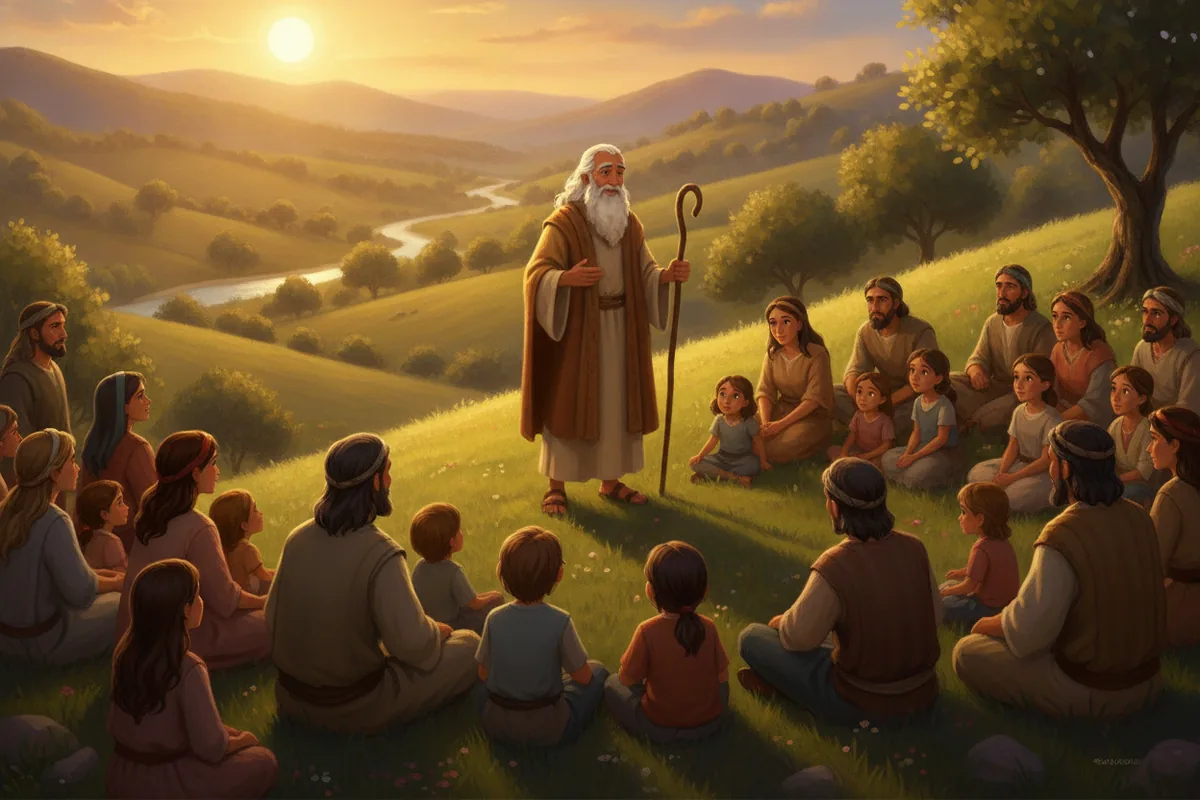
God’s people were camping near a new land. Soon they would go in and live there. Moses, their leader, called them all together. He had something very important to tell them.
First Moses told them about the new land. It was a land flowing with milk and honey! That means a land with lots of good food. Can you rub your tummy and say, “Mmm”?
Then Moses said, “Hear, Israel: The LORD is our God. The LORD is one.” There is only one true God. Can you hold up one finger? Just one!
Then Moses said, “You shall love the LORD your God with all your heart. With all your soul. And with all your might.” Might means strength. So we love God with everything we are. Let’s put our hands on our hearts.
“These words shall be on your heart,” Moses said. “You shall teach them diligently to your children.” Diligently means carefully, again and again. God’s words on our hearts, all day long.
When should families talk about God’s words? Moses said, “Talk of them when you sit in your house. When you walk by the way. When you lie down, and when you rise up.”
Let’s do it together! Sit down. Walk, walk, walk. Lie down. Now jump up! Morning and night, inside and outside, God’s words can be with us.
“You shall bind them for a sign on your hand,” Moses said. To bind means to tie. It was like tying a little note to your hand. God wanted his words to be close to them, all the time.
Moses said, “You shall write them on the door posts of your house.” Door posts are the sides of a door. Everyone who came in or went out would see God’s words. God’s words on our hearts, all day long.
Then Moses told them about the good things in the new land. There would be big cities they did not build. There would be houses full of good things. There would be grapevines and olive trees they did not plant. And they would eat and be full.
But Moses said, “Beware lest you forget the LORD.” Beware means be careful. When we have lots of good things, we can forget who gave them.
Someday the children would ask, “What do God’s words mean?” Then their moms and dads should tell them, “We were Pharaoh’s slaves in Egypt. The LORD brought us out of Egypt with a mighty hand.” Slaves are people who are not free. Can you make a strong, mighty fist?
“He brought us out from there, that he might bring us in,” they would say. God took them out of a hard place. And God brought them into the good land he had promised.
God’s words were for his people’s good. They were like a mom’s words when she says, “Hold my hand.” She says it because she loves you. God’s words on our hearts, all day long.
The LORD had saved his people with his mighty hand. And he gave them his good words to keep.
Now it is time to lie down, just like Moses said. And as you lie down, God’s words can stay with you. God’s words on our hearts, all day long.
Talk together
- Where in our home could we talk about God together?
- What would you tell a friend about God?
Memory verse for little ones
“You shall love the LORD your God with all your heart” — Deuteronomy 6:5
Pray together
Dear God, you are the one true God. Thank you for your words. Please put them in my heart. Amen.
The whole story (ages 6+)
Long ago, an old and gentle leader named Moses gathered God's people together. They stood near the edge of a beautiful new land that God had promised to give them. Moses had lived a very long life, and now he had one last treasure to share — the most important thing anyone could ever know about God.
Moses looked out at all the moms and dads and little children. His voice was warm and kind as he spoke the words God had given him. "Hear, O Israel! The Lord our God is the one true God." Everyone grew quiet and still so they could listen.
Then Moses told them God's greatest wish for their hearts. "Love the Lord your God with all your heart, with all your soul, and with all your strength." It meant loving God with every single part of who you are — your thoughts, your feelings, and everything you do all day.
Moses wanted these loving words to be kept somewhere very special. "Let these words I tell you today stay inside your hearts." Just like a shining treasure kept safe in a box, God's words were meant to be held close forever, day and night.
God's words were not only for grown-ups. Moses said to teach them to the children, again and again and again. "Talk about them at home and on the road, when you lie down and when you get up." That way, families could share God's love all through the day.
To help everyone remember, Moses gave them a joyful idea. "Tie these words on your hands, and write them on the doorposts of your houses and on your gates." Everywhere they looked, there would be a little reminder of God, like small notes of love tucked all around their homes.
Why should they love God so very much? Because God had loved them first — leading them, feeding them, and keeping them safe every day. As the people carried these words home in their hearts, they smiled, knowing that God would always love them, and that His love would never, ever end.
Tricky words
- Moses — A kind leader whom God chose to guide His people and share His words with them.
- soul — The deep, inside part of you that thinks, feels and loves.
- strength — All the energy and power you have to do the things you do.
Where is Jesus in this story?
Many years later, someone asked Jesus which command was the most important of all. Jesus answered with these very words from the Shema: to love God with all your heart, soul and strength. Jesus lived out that perfect love for us, and He showed us how to love others too. Through Jesus, God's rescuing love reaches every child, gently inviting us to love Him back.
Love God with all you are
God doesn't want just a tiny bit of our love — He wants all of it, because He loves all of us. When we love God with our heart, our soul and our strength, that love spills out into everything we do: how we play, how we speak, and how we treat the people around us. And the very best part is that we get to love God because He loved us first, gently and forever.
Memory verse
“You shall love the LORD your God with all your heart, with all your soul, and with all your might.” — Deuteronomy 6:5 · WEB
A little prayer
Dear God, thank You for loving me first. Help me to love You with all my heart, all my soul and all my strength. Please keep Your words safe inside me, and help me share Your love wherever I go today. Amen.
Questions kids ask
What does the word Shema mean?
Shema is the Hebrew word for “hear” or “listen.” It is the first word of the famous verse “Hear, O Israel: The Lord our God, the Lord is one” (Deuteronomy 6:4). Many Jewish families still say these words when they get up and when they go to bed (Deuteronomy 6:7).
What did Jesus say about the Shema?
When a teacher of the law asked Jesus which commandment was the most important, Jesus answered with the Shema: “Hear, O Israel: The Lord our God, the Lord is one. Love the Lord your God with all your heart” (Mark 12:29–30). Then He added, “Love your neighbor as yourself” (Mark 12:31).
Why did Moses tell parents to write God's words on their doorframes?
Moses wanted God's words to be part of everyday life. He told parents to talk about them at home and on the road, to tie them on their hands and foreheads, and to write them on doorframes and gates (Deuteronomy 6:7–9). Some Jewish families still put a small scroll called a mezuzah on their doors.
What does loving God with all your heart, soul and strength mean in the Shema?
It means loving God with everything you are: your feelings and thoughts, your whole life, and all your energy (Deuteronomy 6:5). Moses said these commands should be “on your hearts” (Deuteronomy 6:6). Love like that is not just a feeling; it shows in what we choose every day.
Keep reading
Love the Lord — The Shema quiz · Coloring page 1 · Coloring page 2 · Sunday school lesson · Bible Stories About Family
Home · All stories · Topics · Coloring pages · Quizzes · Sunday school lessons