Let My People Go
Exodus 5 · Bible story for toddlers and preschoolers
Brave Moses and Aaron march into Pharaoh's palace with four bold words from God — but will the mighty king ever let God's tired people go free?
The little story (ages 3–6, 6 min)
God’s people, Israel, were slaves in Egypt. A slave has to work for someone else and is not free to go. They had to work very hard for Pharaoh, the king. God heard his people.
All day long they made bricks from mud and straw. Straw is dry grass. It helps the mud bricks hold together.
God sent Moses and his brother Aaron to Pharaoh. They said, “This is what the LORD, the God of Israel, says. ‘Let my people go, that they may hold a feast to me in the wilderness.’” A feast is a big meal to celebrate. Can you say it with a strong voice? Let my people go!
But Pharaoh said, “Who is the LORD, that I should listen to his voice? I don’t know the LORD, and moreover I will not let Israel go.”
Moses and Aaron asked again. “Please let us go into the wilderness, and sacrifice to the LORD, our God.” To sacrifice means to give a gift to God.
But Pharaoh would not listen. “Get back to your burdens!” he said. Burdens are heavy loads and hard work.
That same day, Pharaoh gave a new order to the bosses. “You shall no longer give the people straw to make brick. Let them go and gather straw for themselves.” But they still had to make just as many bricks as before!
So the people went all over Egypt to find straw. Hurry, hurry! Can you pretend to pick up straw, fast, fast, fast? But they could not make enough bricks. The bosses were very hard on them. God heard his people.
The leaders of God’s people went to Pharaoh. “Why do you deal this way with your servants?” they asked. But Pharaoh said, “You are idle! You are idle!” Idle means lazy.
Then the leaders were upset with Moses and Aaron. “You have made things worse for us!” they said.
Moses went back to the LORD and prayed. “Lord, why have you brought trouble on this people? Why is it that you have sent me?” Maybe Moses felt very sad.
Then the LORD spoke to Moses. “Now you shall see what I will do to Pharaoh.” God said, “I am the LORD. I have heard the groaning of the children of Israel.” Groaning means sad, tired crying. God heard his people.
God said, “I will bring you out from under the burdens of the Egyptians. I will redeem you with an outstretched arm.” Redeem means to set free. An outstretched arm is a strong arm, reaching out. Can you stretch out your arm, strong and long?
God said, “I will take you to myself for a people. I will be your God.” God also promised them a land. It was the land he had promised to Abraham, Isaac, and Jacob.
Moses told the people what God said. But they were too tired and too sad to listen. Their work was so hard.
But God had heard them. And God was going to set his people free. God heard his people.
Talk together
- How do you think the people felt when there was no more straw?
- What do you think Moses felt when he went to pray?
Memory verse for little ones
“Let my people go” — Exodus 5:1
Pray together
Dear God, thank you that you hear when people are sad and tired. Thank you that you hear me too. Amen.
The whole story (ages 6+)
Far away in the land of Egypt, God's people worked from morning till night, making bricks under the hot sun. They were tired and sad, but God had not forgotten them. He chose two brothers, Moses and Aaron, to help. God had a rescue plan, and it was about to begin.
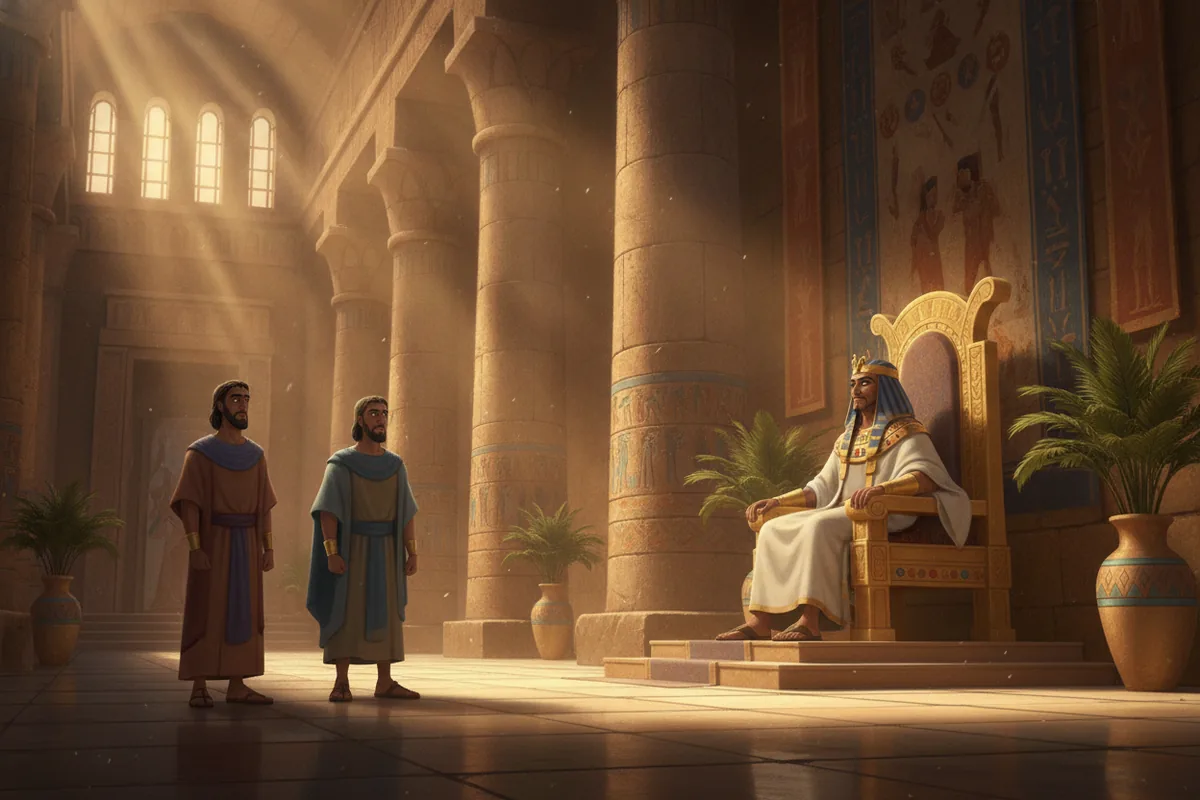
Moses and Aaron walked bravely into the king's grand palace. The king of Egypt was called Pharaoh, and he sat high on a golden throne. The brothers stood tall and said, "The Lord God says, let my people go so they can worship him in the desert." Their voices did not shake, for God was with them.
But Pharaoh frowned and shook his head. "Who is this Lord?" he asked. "I do not know him, and I will not let the people go." His heart was as hard as stone, and he would not listen to God's words.
That very day, Pharaoh grew cross and unkind. He called his slave masters and gave a mean new order. "Stop giving the people straw for their bricks," he said. "Let them find their own, but they must still make just as many." He wanted to make their work even harder than before.
So God's people hurried all over Egypt, searching for bits of straw in the fields. Their hands grew sore and their backs grew weary, yet the piles of bricks were never enough. The poor workers felt tired and worried, and they did not know what to do.
The leaders of God's people came to Moses with sad faces. "Why has everything become worse since you spoke to Pharaoh?" they asked. Moses felt his heart grow heavy, and he wondered if the plan had gone wrong. Even brave helpers can feel sad and unsure sometimes.
So Moses did the very best thing of all — he talked to God. "Lord, why is this so hard?" he prayed. And God answered gently, promising that he would surely set his people free. Moses learned that God always keeps his promises, even when we have to wait.
Tricky words
- Pharaoh — Pharaoh was the powerful king who ruled over the whole land of Egypt long ago.
- straw — Straw is the dry yellow stalks left from grain, which were mixed into mud to make bricks.
- bricks — Bricks are blocks made from dried mud that people used to build walls and buildings.
- palace — A palace is a very big and grand house where a king or queen lives.
- worship — To worship means to show love and thanks to God with songs and prayers.
Where is Jesus in this story?
Moses told Pharaoh, “Let my people go,” because Israel was trapped as slaves. Jesus spoke about another kind of slavery: “Everyone who sins is a slave to sin,” He said. Then He promised, “If the Son makes you free, you will be truly free” (John 8:34–36). Moses freed people from Pharaoh, but Jesus frees our hearts from sin forever.
God Never Forgets You
Even when things felt harder than ever, God had not forgotten his people. Sometimes we have to wait, and waiting can feel difficult. But this story shows us that God sees every tear and hears every prayer. He is always working to help us, even when we cannot see it yet. We can trust him, because he loves us and always keeps his promises.
Memory verse
“Moses and Aaron came, and said to Pharaoh, "This is what the LORD, the God of Israel, says, 'Let my people go.'"” — Exodus 5:1 · WEB
A little prayer
Dear Lord, thank you that you never forget me. When things feel hard or I have to wait, help me to trust you. Thank you for always keeping your promises and for loving me so very much. Amen.
Questions kids ask
What did Moses and Aaron say to Pharaoh?
They said, “This is what the Lord, the God of Israel, says: ‘Let my people go so they may hold a feast for me in the desert’” (Exodus 5:1). Pharaoh answered, “Who is the Lord? Why should I obey him? I do not know the Lord, and I will not let Israel go” (Exodus 5:2).
Why did Pharaoh stop giving straw to the Israelites?
Pharaoh was angry and said the Israelites were lazy. He ordered that they must now gather their own straw but still make the same number of bricks as before (Exodus 5:7–8). That made their work much harder, and he hoped they would stop listening to Moses (Exodus 5:9).
Why were the Israelites angry with Moses after he met Pharaoh?
After Pharaoh made the work harder, the Israelite foremen were beaten (Exodus 5:14). They blamed Moses and Aaron for making Pharaoh hate them (Exodus 5:20–21). Moses took his worry straight to God, and God promised, “Now you will see what I will do to the king of Egypt” (Exodus 6:1).
Keep reading
Let My People Go quiz · Coloring page 1 · Coloring page 2 · Sunday school lesson · Moses and the Exodus
Home · All stories · Topics · Coloring pages · Quizzes · Sunday school lessons