The Ten Plagues of Egypt
Exodus 7-11 · Bible story for kids
Ten amazing wonders sweep across Egypt as brave Moses asks the mighty Pharaoh to set God's people free at last - will the proud king finally say yes?
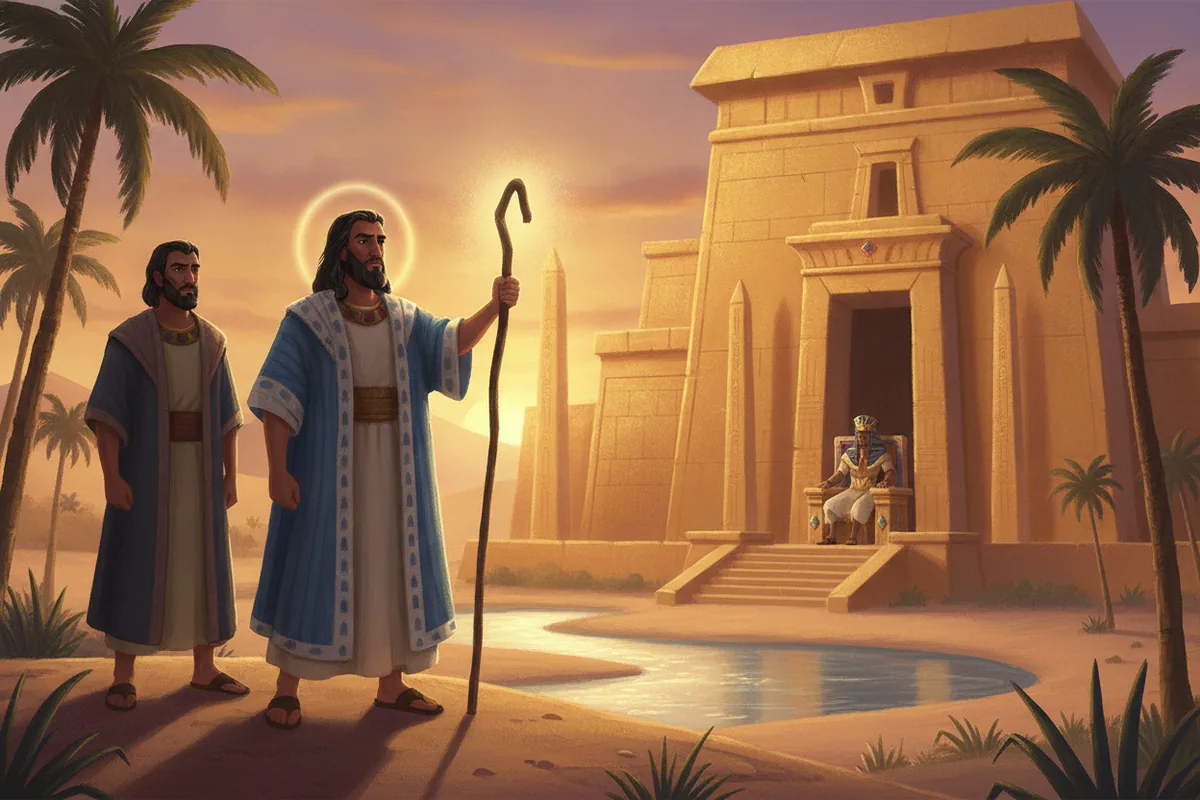
Long ago, God's people lived in the land of Egypt, and they were very sad. They had to work as slaves all day long under the hot, blazing sun. God heard every one of their cries, and He chose a kind, brave man named Moses to help them. God had a wonderful plan to set His people free.
Moses and his brother Aaron walked bravely into the king's grand palace. The king of Egypt was called Pharaoh, and he was very, very proud. Moses said, "Let my people go!" But Pharaoh crossed his arms and answered, "No!" His heart was hard as stone, and he would not listen.
So God began to send special signs, called plagues, to show His mighty power. Moses stretched out his staff, and the water of the great river turned into blood, so the fish died and no one could drink it. Then frogs hopped everywhere — in the beds, in the bowls, and even in the ovens! Still Pharaoh shook his head and said, "No, they cannot go."
Next came tiny buzzing gnats and thick clouds of flies. The Egyptians' farm animals got sick and died, and painful sores appeared on people's skin. Then big lumps of icy hail came crashing down from the sky. But God kept His own people safe in their homes in a place called Goshen.
After that, hungry locusts ate every green leaf in the whole land. Then, for three long days, a thick darkness covered Egypt. Nobody could even see their own hands in front of them! Yet in the homes of God's people, there was still light.
On the very last night came the saddest sign of all: the oldest son in every Egyptian family died, even in Pharaoh's own palace. But God gave His people a way to be safe. Each family painted a little lamb's blood around their door, and God passed over every home marked with the blood. That night Pharaoh finally cried, "Go! Take your people and leave!" At last, his stubborn heart gave way.
So God's people hurried out of Egypt that very night, carrying bread dough that had no time to rise. They were free at last, just as God had promised them! Moses led them out toward a bright and hopeful new day. God always keeps His promises, and He never, ever forgets His children.
Tricky words
- plague — A plague is a big trouble or problem that comes to many people all at once.
- Pharaoh — Pharaoh was the special name for the king who ruled the whole land of Egypt.
- slaves — Slaves are people who are forced to work very hard and are not allowed to be free.
- locusts — Locusts are big jumping insects, a bit like grasshoppers, that eat lots and lots of plants.
- Goshen — Goshen was the special part of Egypt where God's people lived and stayed safe.
- stubborn — Being stubborn means you refuse to change your mind, even when you really should.
- plagues — Terrible troubles that God sent on Egypt as signs of His power.
Where is Jesus in this story?
Moses' first plague turned the Nile's water into blood, and the plagues brought sadness and judgment to Egypt. Jesus' first miracle turned water into wine at a wedding and brought joy (John 2:11). John explains the difference: “The law was given through Moses, but grace and truth came through Jesus Christ” (John 1:17). Jesus came to heal and save you.
God Rescues His People
The Ten Plagues show us that God is strong and full of love. When His people were sad and stuck, God did not forget about them for even a moment. He was patient and powerful, and He kept every single one of them safe. Whenever you feel worried or small, you can remember that God sees you too. He loves you and is always working to care for you, just as He cared for His people long ago.
Memory verse
“I am the LORD, and I will bring you out from under the burdens of the Egyptians.” — Exodus 6:6 · WEB
A little prayer
Thank You, God, for being so strong and so full of love. Thank You for saving Your people and for always remembering me too. Please help me to trust You when things feel hard. I know that You are always right here with me. Amen.
For grown-ups: Exodus 7–12 describes ten plagues, including the Nile turning to blood, the death of livestock, and finally the death of every firstborn in Egypt (12:29–30). We name the tenth plague simply and gently; it came after Pharaoh had refused again and again and had ordered Israel's baby boys drowned (Exodus 1:22). Christians see the Passover lamb as pointing to Jesus (1 Corinthians 5:7).
Questions kids ask
What were the ten plagues of Egypt in order?
Water turned to blood, frogs, gnats, flies, sick livestock, boils, hail, locusts, darkness, and the death of the firstborn (Exodus 7–11). Each plague showed that the Lord was far more powerful than Pharaoh and all the gods of Egypt (Exodus 12:12).
Why did God send the plagues on Egypt?
Pharaoh refused again and again to let God's people go (Exodus 5:2). God sent the plagues to set Israel free and so that “the Egyptians will know that I am the Lord” (Exodus 7:5). They also showed that Egypt's false gods had no power at all (Exodus 12:12).
What does it mean that God hardened Pharaoh's heart?
It means Pharaoh became stubborn and would not listen. Several times the Bible says Pharaoh hardened his own heart (Exodus 8:15, 32), and other times that God hardened it (Exodus 9:12). God confirmed the choice Pharaoh kept making, and He used it to show His power.
Did the ten plagues hurt the Israelites too?
Not all of them. God made a difference between Egypt and His people. There were no flies in Goshen, where Israel lived (Exodus 8:22), none of the Israelites' animals died (Exodus 9:6), no hail fell in Goshen (Exodus 9:26), and the Israelites had light during the darkness (Exodus 10:23).
Keep reading
The Ten Plagues of Egypt quiz · Coloring page 1 · Coloring page 2 · Sunday school lesson · Moses and the Exodus
Home · All stories · Topics · Coloring pages · Quizzes · Sunday school lessons